Address jigging: what to change and what to leave alone
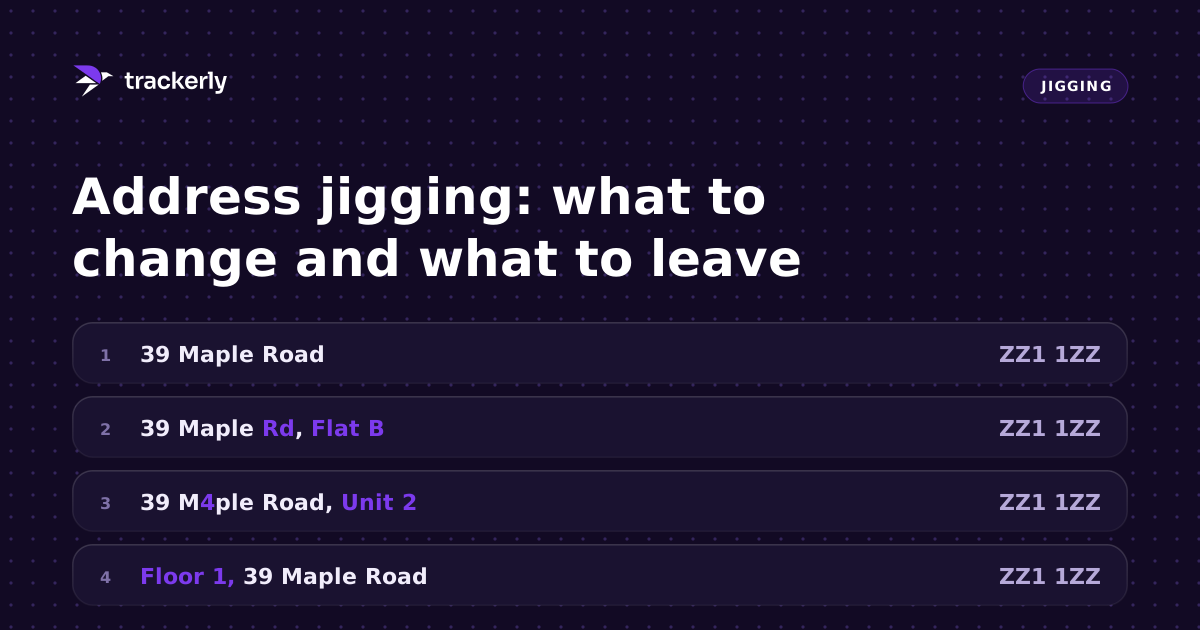
Address jigging means writing one real address lots of slightly different ways, so each checkout profile looks like a different person to a shop with a one-per-customer limit, while the courier still delivers every parcel to your door. You change how the name and the street are written. You never change the house number or the postcode.
The two things you never touch
The house number and the postcode. They are what the post is actually sorted on. Get them right and a courier will deliver almost anything you write around them. Get them wrong and the parcel goes somewhere else.
They are also what a card's address check reads. When billing is set to the same as shipping, a jigged billing address still passes that check, because the number and postcode match what the bank holds. Change either one and the payment is the thing that fails.
There is one exception worth knowing. Pokémon Center UK lets you get away with a postcode jig, the last letters changed to ones near yours, with billing kept real. That one has its own write-up.
What you can change
- The street. Short forms (Rd for Road, St for Street), small spelling slips, letters swapped for numbers, dots between letters.
- Extra lines. A flat, a floor, an annexe, a unit. Couriers mostly ignore them, shops read them as a different address.
- The county. Dropping it changes how the address reads and costs nothing.
- The name. Your own name written different ways, initials, a middle name. Or other names entirely, though see below.
How far to push it
Think of it as three levels.
- Light uses short forms only. Nothing a shop can fault, but a small pool before profiles start repeating.
- Medium adds names written the way other languages write them and drops the county. A bigger pool, still clean.
- Harsh adds initials and invented flats, floors and annexes. The biggest pool, and the most likely to be spotted.
Spelling errors sit on top of whichever level you pick. Mixing a few kinds, common slips and letters for numbers say, makes neighbouring profiles differ in kind as well as value.
Two cautions. A checkout that looks your address up as you type can reject a misspelling outright. And couriers differ in how well they sort a heavily jigged address. Push it as far as you are comfortable losing, not further.
Random names are a trade
Using names that are not yours gives you a far bigger pool. It also puts a stranger's name at your address, which is exactly the pattern fraud checks look for. Varying your own name is the safer default.
Phone numbers and emails
Your own phone number, written every way the UK writes it, keeps the courier able to reach you. Made-up numbers can reach real strangers.
For emails, a catch-all domain is the strong version: every profile gets its own address at your domain and it all lands in one inbox. Shops strip Gmail dots and plus-tags, so a short list of those reads as a short list.
How many profiles per address?
It depends on the shop, and it changes. Some are strict about how many orders go to one door. Others do not care at all: for John Lewis, for example, fifty profiles to one address is fine as long as every line is written differently. We have written that one up on its own. Shopify stores and Topps sit at the other end, at about two to one.
How Trackerly does it
Jig & Profiles is a page in the desktop app, off until you switch it on in Settings, Preferences, Optional pages.
- Addresses holds the real addresses you save, in folders, with alternate names to widen the pool.
- Cards is your wallet, encrypted on your computer and never synced.
- Generate turns the addresses and cards you switch on into profiles. Pick how many per address, Light, Medium or Harsh, your spelling options, and how names, phones and emails are written. Preview shows exactly what it will make before you press Generate.
Your house number and postcode are never changed, whatever you pick. Each run is saved as a batch, and a later batch never deals a jig an earlier one already gave out. Mark profiles you really used as used or burned and they are never dealt again.
When you are done, export straight into your bot's own format, or a plain CSV. Already have profiles in a bot? Import its file and Trackerly reads the real addresses back out of it.
One thing to be careful with: a bot file holds card numbers in plain text, because the bot has to read them. Keep it somewhere private and delete it once it is imported.
Start your 7-day free trial and build your next batch of profiles in a couple of minutes.
Track every order, fee and flip in one place.
Trackerly is a desktop app for resellers, and your data stays on your machine. 7 days free, then £14.99 a month.
Start free trial